

Table of Contents
- How to Choose the Right Roll-Off Dumpster Sizes for Your Project
- What You’ll Need Before Booking Dumpster Rentals Near Me
- How the Dumpster Rental Process Works, Step by Step
- Dumpster Rental Weight Limits and How to Avoid Overage Charges
- Prohibited Items for Dumpsters: What Never Goes In
- How to Load a Dumpster Efficiently (and Safely)
- Common Mistakes That Delay Pickup and Cost You Money
- Frequently Asked Questions
Last Updated: September 13, 2026
How to Choose the Right Roll-Off Dumpster Sizes for Your Project
Booking dumpster rentals near me starts with one decision: container size. Get it right and the project moves; get it wrong and you’re either paying for air or ordering a second container mid-demolition. At Austex Dumpsters, we size jobs every day, and the pattern is predictable. Most homeowners overestimate volume and underestimate weight.
Roll-off dumpster sizes are measured in cubic yards, which describes volume, not weight. A 15-yard container holds roughly 15 cubic yards of debris. The four sizes available are 15, 20, 25, and 30 yards.
Here’s the part most guides skip: heavy material changes the math entirely. Large amounts of concrete, dirt, brick, or rock must go in a 15-yard dumpster regardless of how little space they appear to take up. A half-full 20-yard container of broken concrete will exceed its load limit long before it looks full.
Matching 15, 20, 25, and 30-Yard Containers to Real Jobs
Use this as your starting framework, then adjust for how you load:
| Container | Best For | Watch Out For |
|---|---|---|
| 15-yard | Heavy debris: concrete, dirt, brick, rock; small cleanouts | Fills fast with bulky light items |
| 20-yard | Mid-size remodels, deck removal, garage cleanouts | Heavy material is not permitted |
| 25-yard | Whole-home cleanouts, roofing tearoffs, additions | Needs clear driveway access |
| 30-yard | Large construction and demolition, multi-room renovations | Placement space and permit requirements |
A roofing tearoff is the classic example. Shingles are heavy and bulky at the same time, so contractors typically step up to a 25-yard container rather than risk an overweight 20.
If your load is clean concrete, dirt, brick, or rock with no trash mixed in, ask about a tonnage break on a 15-yard container when you book. Contamination is what kills the discount, so keep the load pure.
What You’ll Need Before Booking Dumpster Rentals Near Me
Three checks take ten minutes and prevent almost every delivery problem. Do them before you call, not after.
Driveway check. Measure the width of your driveway and any gate opening. The delivery truck needs room to back in and set the container down, plus overhead clearance for the roll-off mechanism. A standard roll-off truck needs roughly 12 feet of width and about 23 feet of vertical clearance to raise the rail; low branches and utility drops are the usual culprits when a driver has to abort (osha.gov).
Access check. Note low-hanging branches, parked cars, and soft ground. A loaded container is heavy enough to crack a driveway that isn’t rated for it, and plywood under the rails is cheap insurance. If the only flat spot is on grass after rain, expect ruts, and plan to lay down plywood or move the placement.
Permit check. If the container sits on a public street rather than private property, a right-of-way permit typically applies. This is the step renters underestimate most, so here is the actual sequence:
- Confirm jurisdiction. The permit comes from the city or county that owns the street, not from the rental company. If you live just outside city limits, the county may handle it instead.
- Gather the basics. Most offices ask for the service address, the placement dates, the container dimensions, and sometimes a sketch or photo of where it will sit.
- Ask about the inspection window. Some jurisdictions require a site check before the permit is issued; others issue same-day over the counter or online.
- Post the permit. Many cities require the approved permit to be visible on or near the container during the rental.
- Mind the clock. Permits are usually issued for a set number of days, and the container has to be gone by the expiration date.
Rules vary by jurisdiction, so confirm with your local office before the truck rolls. city permit requirements for right-of-way use
Skipping the permit check is the single most common cause of a same-day delivery falling through. If the container can’t legally sit where you planned, the driver has to leave, and your project stalls, and in some jurisdictions an unpermitted container can be ticketed or towed.
How the Dumpster Rental Process Works, Step by Step
The rental process follows a short, predictable sequence. Knowing it upfront means fewer phone calls and no surprises on delivery day.
- Estimate your volume and material type. Separate heavy debris from general household junk in your planning.
- Choose your container size using the table above.
- Confirm placement and check whether a street permit is needed.
- Book your rental period. Tell the dispatcher your target start and end dates.
- Prepare the site by clearing the delivery path.
- Load the container as the project progresses.
- Schedule pickup before your rental period ends.
Same-day delivery is available when routes allow, so it’s worth asking about timing when you book rather than assuming. For a Saturday start, call ahead. Availability on weekends tightens fast.
How long does a dumpster rental period last? Standard rental periods run about a week for residential projects, with longer terms available for construction sites. Confirm your exact window in the rental agreement before you sign, and schedule pickup before it expires to avoid extension charges.
Dumpster Rental Weight Limits and How to Avoid Overage Charges
Every container carries a weight allowance, and exceeding it triggers overage charges billed per ton. This is where budgets break: the container looks half empty, but the scale says otherwise.
Dense materials are the culprit. Concrete, dirt, brick, and rock pack enormous weight into small volume, which is exactly why they belong in a 15-yard container and nowhere else. Roofing shingles behave the same way.
The practical fix is load discipline:
- Put heavy material in first, spread evenly across the floor
- Keep heavy debris out of the 20, 25, and 30-yard containers entirely
- Never top off a heavy load with household trash
- Ask what your container’s allowance is before you start loading
Weight, not volume, is what generates overage fees. If your load is dense, size down and book a 15-yard container rather than gambling on a bigger one.
Prohibited Items for Dumpsters: What Never Goes In
Some items cannot go in a roll-off container, no matter the size. Prohibited items for dumpsters fall into a few clear categories, and mixing them in can void your rental or trigger a refusal at pickup.
- Hazardous waste: paint, solvents, motor oil, pesticides, antifreeze
- Tires and automotive batteries
- Refrigerants and appliances containing them, such as refrigerators and AC units
- Electronics covered by state e-waste rules
- Medical waste and sharps
- Ammunition, flares, and explosives
How to Actually Get Rid of the Stuff Your Dumpster Won’t Take
Most guides stop at the list. The harder question is what to do with the items once you know they can’t go in. Here is the practical path for each category.
Household hazardous waste (paint, solvents, oil, pesticides, antifreeze). Nearly every county runs periodic household hazardous waste collection events, often monthly or quarterly, and many operate a permanent drop-off site. Check your county’s solid waste department page for the schedule and what they accept. Keep liquids in their original labeled containers when possible; if a container is unlabeled, most facilities will still take it but may ask you to describe the contents. Never pour these down a drain or into a storm sewer, that is a separate violation from the dumpster rules.
Tires and automotive batteries. Retailers that sell tires and batteries are often required to accept a limited number back for recycling, and auto parts stores frequently take both. Batteries carry a core charge, so returning them is usually free or credited.
Refrigerant appliances (refrigerators, freezers, AC units). These need the refrigerant recovered before the unit is scrapped. Many municipal transfer stations and appliance recyclers handle this; some utilities also run appliance pickup programs. Ask before you haul it to the curb.
Electronics. State e-waste rules vary, but the common path is a manufacturer or retailer take-back program, a county e-waste event, or a certified electronics recycler. Do not put them in the roll-off.
Medical waste and sharps. Use a sharps mail-back program or a pharmacy drop-off. Never place sharps loose in any container, that is a direct injury risk to transfer station staff.
Ammunition, flares, and explosives. Contact your local police or fire department non-emergency line for guidance. Do not transport these to a landfill or transfer station.
household hazardous waste disposal guidance explains why these materials need separate handling: they contaminate otherwise recyclable loads and create real risk for transfer station staff.
Recycling guidelines matter here too. Clean cardboard, metal, and yard waste can often be diverted rather than landfilled, and keeping recyclables separate supports waste diversion goals on larger job sites. If you are unsure whether an item is banned, ask the dispatcher before you load it, a two-minute call beats a refused load and a sorting charge.
Build a small “no-go” pile as you clean out, then route each item to its proper channel, county HHW event, retailer take-back, or recycler, before the dumpster arrives. That single habit prevents the most expensive pickup refusal.
How to Load a Dumpster Efficiently (and Safely)
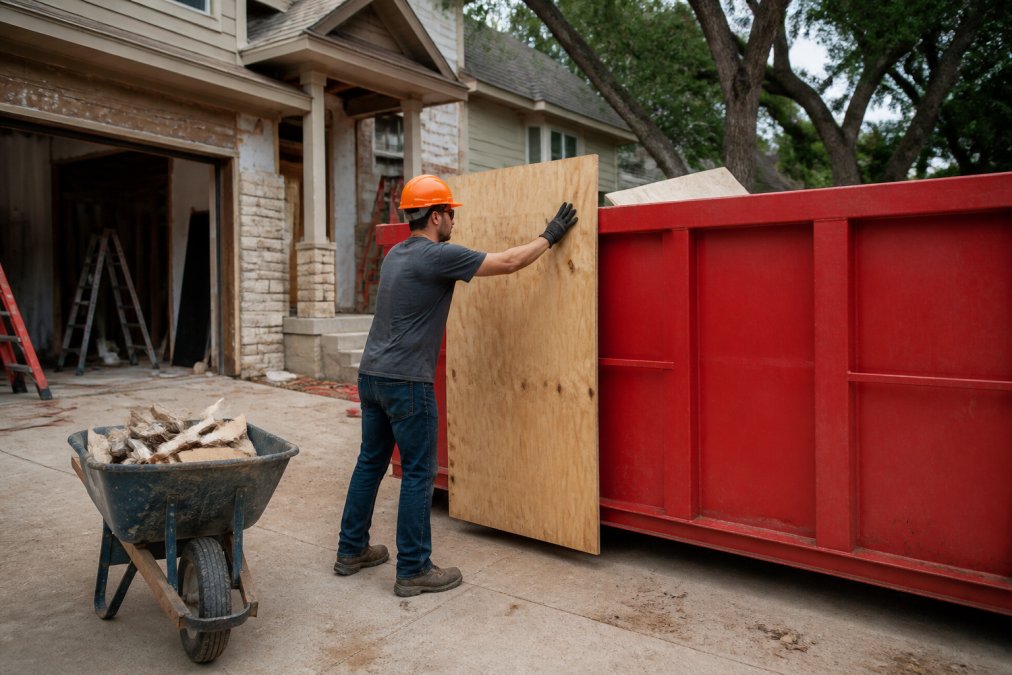
Load flat, load low, and load heavy first. Those three rules prevent most injuries and most overage charges.
Walk the heaviest items in first and distribute them across the floor of the container rather than piling them in one corner. Break down bulky items like furniture and cabinets so they stack instead of creating hollow pockets of wasted space. Keep the load below the top rail so the driver can tarp it safely, and never climb into a container to stomp down debris.
How to load a dumpster efficiently comes down to sequence. Heavy and flat at the bottom, bulky and light on top, nothing overhanging the sides. A container loaded this way usually holds more usable volume than one packed in a rush.
Lay a sheet of plywood against the side you’re throwing into. It protects the container’s paint and stops sharp debris from snagging as it goes over the rail.
Common Mistakes That Delay Pickup and Cost You Money
Pickup delays almost always trace back to the same handful of errors. Each one is avoidable with a two-minute check.
- Overloading above the rail. Drivers can’t legally transport an overfilled container, so it sits until you unload it.
- Blocking access after delivery. A car parked in front of the container means the truck can’t reach it.
- Mixing prohibited materials. The load gets refused or rerouted, and you pay for the sorting.
- Letting the rental period lapse. Extensions cost more than booking the right window upfront.
- Forgetting to schedule pickup. The container doesn’t leave on its own. Call before your period ends.
For property managers running multiple cleanouts, recurring pickups remove most of this friction. Set a standing schedule instead of calling for each site, and the containers rotate without anyone chasing dates.
That’s the framework: size by material, not by eyeball. Check access and permits before you book. Load heavy first and keep prohibited items out. Do those four things and the container arrives, fills, and leaves on schedule.
Frequently Asked Questions
How do I know what size dumpster I actually need?
Match the container to the debris type and volume. A 15-yard works for heavy materials like concrete, dirt, brick, or rock, and Austex requires those loads in a 15-yard. For general household junk, a 20-yard fits a garage or single-room cleanout, a 25-yard handles a multi-room renovation, and a 30-yard suits large demolition or whole-home cleanouts. When in doubt, ask for sizing guidance before you book so you don’t pay for space you won’t fill.
Are there specific materials that cannot go into a dumpster?
Yes. Prohibited items for dumpsters typically include hazardous waste, paint and solvents, motor oil, tires, batteries, appliances with refrigerant, and electronics. These require separate disposal under environmental compliance rules. Mixing them into a load can trigger rejection, extra fees, or a delayed pickup. If you’re unsure about an item, ask before you toss it in so the load stays clean and your project stays on schedule.
How long can I keep a rented dumpster on my property?
Most short-term rentals run about seven days, and long-term leases are available for multi-week construction or demolition jobs. Confirm your rental period at booking so you aren’t surprised by an extension charge. If your project runs long, call before the scheduled pickup to extend rather than letting the container sit past its window, since a dumpster left in a driveway after the job can hold up your next phase.
What is the process for scheduling a dumpster delivery?
Start by confirming the size, the drop location, and the rental period. Austex offers same-day delivery when available, so a Saturday drop for a weekend tear-off is realistic if you book early. You’ll need a clear path for the truck, and a street permit if the container sits on public right-of-way. After delivery, load it, then schedule pickup and delivery for when you’re done.
Waste removal shouldn’t be the part of your project that slips. Austex Dumpsters offers 15, 20, 25, and 30-yard roll-off containers with same-day delivery when routes allow, expert sizing guidance so you don’t pay for space you won’t use, and straightforward pricing with no surprise per-ton charges. Homeowners, contractors, and property managers across the area rely on us to keep jobs moving. Get started with Austex Dumpsters and request your container today.