

Table of Contents
- Why Debris Removal Delays Landscaping Projects
- Dumpster Sizing for Landscaping Projects
- Heavy Material Disposal Requirements
- Same-Day Dumpster Delivery for Contractors
- Disposal Options for Large-Scale Yard Waste and Debris
- Keeping Landscaping Projects on Schedule with a Waste Management Plan
- Frequently Asked Questions
Last Updated: September 15, 2026
Why Debris Removal Delays Landscaping Projects
Yard waste disposal is the silent schedule-killer on landscaping jobs, and most crews only notice it after a crew has been standing around for half a day. At Austex Dumpsters, we see it constantly: a project stalls not because the planting is behind, but because nobody planned where the trimmings, limbs, and soil were going. A full trailer of brush has to be hauled somewhere, and if that somewhere wasn’t booked in advance, the whole day’s labor gets spent driving instead of building.
The pattern repeats across nearly every large-scale job:
- Crews pile debris on-site “for now,” then lose access to the work area
- A loaded trailer sits idle because the drop-off site closed at 3 p.m.
- Storm cleanup gets delayed waiting on a hauling truck that never got scheduled
The fix isn’t working faster. It’s treating debris removal as a scheduled phase of the project, not an afterthought. Below, we break down how sizing, heavy-material rules, and same-day delivery keep landscaping professionals on schedule.
The most common mistake is assuming you can “figure out disposal later.” When that assumption meets a full site and a closed facility, you lose a full production day. Book disposal capacity before the first truck rolls.
Dumpster Sizing for Landscaping Projects
The right container size depends on the type and volume of debris, not the size of the property. For most landscaping work, a 15-yard container handles general yard waste, while larger containers suit bulky, lightweight material like branches and hedge trimmings.
Matching Container Size to Yard Waste Volume
A common mistake is sizing by square footage instead of by waste stream. Light, bulky organic material takes up far more space per pound than soil or sod, so a job that looks small on paper can fill a container fast.
- 15-yard: general debris, and the required container for heavy material like concrete, dirt, brick, or rock
- 20-yard: bulky yard trimmings, brush, and mixed landscaping debris
- 25 to 30-yard: large-scale clearing, storm cleanup, and multi-phase projects
For sizing guidance specific to your job, our team walks contractors through the decision before delivery so you don’t pay for space you won’t use or order a second container mid-project.
Heavy Material Disposal Requirements
Heavy material follows different rules than organic debris, and ignoring them is how projects get delayed at pickup. Large amounts of concrete, dirt, brick, or rock MUST go in a 15-yard dumpster. Placing that weight in a larger container risks structural failure and refused loads.
Why Concrete, Dirt, and Rock Go in a 15-Yard Container
Weight, not volume, is the constraint. A 20-yard container filled with soil can exceed safe hauling limits long before it looks full, which means the load can’t legally leave the site (fmcsa.dot.gov). Restricting heavy material to 15-yard containers keeps every load within safe limits and avoids the rework of unloading a rejected container.
There’s a practical upside, too. A 15-yard dumpster filled with clean concrete, dirt, brick, or rock, with no trash or other contamination, may qualify for a break on tonnage. Keeping heavy loads clean and separated isn’t just good practice; it can reduce what you pay.
Tell the dispatcher upfront when a load will be heavy. Knowing the material type before delivery lets us match the container correctly and flag any tonnage considerations before the truck arrives, not after.
Same-Day Dumpster Delivery for Contractors
Same-day dumpster delivery is realistic when it’s requested early and the container size is confirmed before dispatch. Availability depends on fleet capacity that day, so the earlier a contractor calls, the better the odds of a same-day drop.
For contractors, the value is simple: a dumpster on-site the morning a job starts means the crew clears debris as it’s generated instead of stockpiling it. That keeps the site safe, keeps the work area accessible, and removes the end-of-project scramble.
A few habits that make same-day delivery work in your favor:
- Call as soon as the start date is confirmed
- Confirm the container size and material type in one conversation
- Give the delivery address and any site access details upfront
- Schedule pickup at the same time as delivery
That last point matters more than most contractors expect. Scheduling pickup when you book delivery prevents the container from sitting in a driveway for days after the work is done.
Fill Out Form to Request Dumpster Rental →
Disposal Options for Large-Scale Yard Waste and Debris
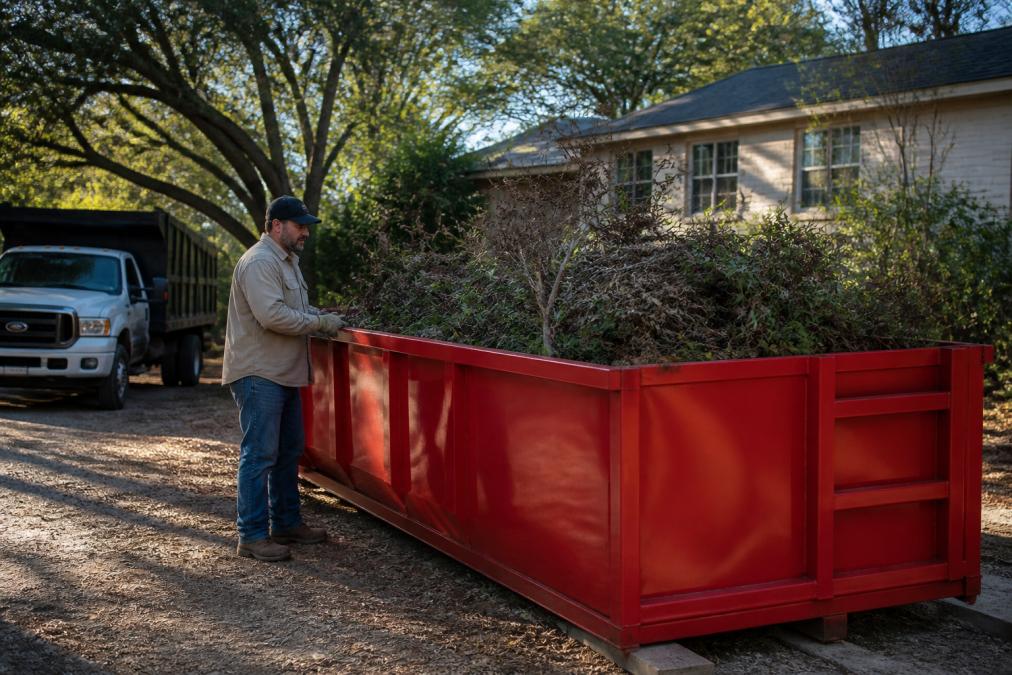
Three main options cover most landscaping debris: roll-off dumpster rental, drop-off facilities, and full-service junk removal. Each fits a different project profile, and choosing the wrong one is a common source of cost overruns. What most guides skip is the actual math a contractor needs to run before committing, because the cheapest option on paper is rarely the cheapest option on the schedule.
Roll-Off Dumpsters vs. Drop-Off Facilities vs. Junk Removal
The trade-off comes down to who does the hauling, how much debris you’re generating, and what a crew hour is worth to you.
| Option | Best For | Trade-Off | Hidden Cost |
|---|---|---|---|
| Roll-off dumpster rental | Ongoing, high-volume, multi-phase projects | You load it yourself | None if pickup is scheduled with delivery |
| Drop-off facility | Crews already running trucks between jobs | You haul every load | Fuel, tipping time, and a truck out of rotation |
| Junk removal service | One-time, loose debris, tight-access sites | Higher cost per load | Premium for labor you could absorb yourself |
Drop-off sites work well for crews already running trucks between jobs, but they require the contractor to transport every load. Junk removal suits quick, one-time clearings where nobody wants to load. For recurring, large-scale work, a roll-off container on-site almost always wins on labor. Managing these logistics efficiently prevents site bottlenecks, though unexpected debris surges occasionally necessitate the flexibility of same-day junk removal to keep projects on schedule.
The Labor Math Most Contractors Skip
A two-person crew billing out at typical landscaping rates burns real money every hour it spends on disposal logistics instead of billable work (Occupational Employment and Wage Statistics (OEWS) Tables ). A single round trip to a drop-off facility can consume a meaningful chunk of a production day once you account for loading, driving, waiting in line, tipping, and driving back. Multiply that by every load a large clearing generates, and the labor cost of self-hauling often exceeds the rental cost of a container parked on-site.
Run the comparison this way before you commit:
- Estimate the number of trailer or truck loads the project will generate.
- Multiply by the round-trip time to the nearest facility, including wait time.
- Multiply that total by your crew’s blended hourly cost.
- Compare that number against a roll-off container delivered once and picked up once.
When the project spans multiple days or phases, the container almost always wins, not because the rental is cheap, but because it converts disposal from a recurring labor task into a one-time logistics event.
Matching the Option to the Project Phase
Disposal needs change as a job progresses, and the best contractors switch methods mid-project rather than locking into one.
- Clearing and demolition phase: highest debris volume, heaviest material. A roll-off container on-site from day one prevents pile-up and keeps access lanes open.
- Grading and soil work: heavy material like dirt, rock, and brick MUST go in a 15-yard dumpster. Keeping these loads clean and separated from organic debris may qualify for a break on tonnage.
- Planting and finishing phase: low volume, mostly packaging and trimmings. A drop-off run or a small on-site container handles this without paying for unused capacity.
- Storm cleanup: unpredictable volume. Same-day delivery when available is the difference between clearing a site in a day and losing a week.
For multi-phase jobs, schedule the container delivery to land the morning clearing starts, not the day the pile gets too big to ignore. A container that arrives early costs less than a crew that stands around waiting for one.
When Drop-Off Still Makes Sense
Drop-off facilities aren’t obsolete for professionals.
Keeping Landscaping Projects on Schedule with a Waste Management Plan
Building the Plan: A Phase-by-Phase Framework
Compliance and Documentation for Commercial Debris
A few documentation habits that prevent problems later:
Scheduling Pickup as Part of the Plan
The projects that stay on schedule aren’t the ones with the biggest crews. They’re the ones where disposal was scheduled like any other phase, with the right container, the right material handling, and a pickup booked in advance.
Frequently Asked Questions
What is the most efficient way to manage large-scale yard waste for commercial landscaping?
For commercial landscaping, the most efficient approach is placing a roll-off dumpster on site so crews can load debris continuously without trips to a drop-off facility. Austex Dumpsters offers 15-, 20-, 25-, and 30-yard containers, and sizing guidance helps match the container to your project volume. Pairing the right container with a waste management plan reduces downtime and keeps your project timeline intact.
Are there specific disposal requirements for heavy landscaping materials like rock and dirt?
Yes. Large amounts of heavy material such as concrete, dirt, brick, or rock must go in a 15-yard dumpster with Austex Dumpsters. These materials cannot be placed in 20-, 25-, or 30-yard containers because the weight can exceed safe hauling limits. A 15-yard container filled with clean concrete, dirt, brick, or rock with no trash or contamination may qualify for a break on tonnage.
How do roll-off dumpsters help landscaping professionals maintain project schedules?
Roll-off dumpsters eliminate repeated trips to disposal facilities. Crews load yard trimmings, tree limbs, and hedge trimmings directly into the container on site, then Austex Dumpsters hauls it away. With same-day delivery available when scheduled, you avoid the downtime of waiting for a hauler. This on-demand pickup model keeps your project timeline predictable and prevents debris from piling up.
How can landscaping companies minimize downtime during debris removal?
Schedule your dumpster delivery before the project start date, not after debris accumulates. Austex Dumpsters offers same-day delivery for contractors when available, so confirm your drop-off and pickup windows in advance. Choose the correct container size using sizing guidance to avoid swapping containers mid-project. For recurring commercial work, set up a pickup schedule so you are not calling for service each time.