
Table of Contents
- Assess Your Project and Estimate Dumpster Needs
- Where to Place a Dumpster on Your Property
- Driveway Protection for Dumpster Rental: Surface-Specific Tips
- What Can You Put in a Dumpster: Accepted and Prohibited Materials
- Create a Dumpster Delivery Preparation Checklist
- Clear Obstacles and Prepare the Delivery Area
- Confirm Permits and Property Access
- How to Prepare for Dumpster Delivery: Final Steps Before Arrival
- Frequently Asked Questions
Last Updated: October 10, 2026
Assess Your Project and Estimate Dumpster Needs
The first step to prepare for dumpster delivery is understanding exactly what you’re throwing away. Overestimate and you’ll pay for unused space; underestimate and you’ll need a costly second dumpster mid-project.
Here’s how to estimate realistically:
- Small cleanouts (attic, closet, single room): 15-yard dumpster usually works
- Home renovation debris (kitchen remodel, bathroom gut): 20-yard dumpster handles most
- Roofing projects (full tearoff with shingles): 15-yard dumpster for heavy materials
- Yard waste and landscaping: 20- or 25-yard depending on scope
- Commercial office cleanout: 25- or 30-yard for multiple rooms
At Austex Dumpsters, we recommend thinking about weight, not just volume. Heavy materials like concrete, dirt, brick, and rock pack into a 15-yard dumpster quickly because weight limits matter more than space.
If you’re unsure between two sizes, ask yourself: “Will I regret not having more space?” If yes, go up a size. Adding a second dumpster mid-project costs more than upgrading upfront.
Where to Place a Dumpster on Your Property
Placement determines whether delivery goes smoothly. A poor location creates access problems, damages your property, or forces the driver to make multiple attempts.
Check for Flat, Level, and Stable Ground
The dumpster needs solid footing. Uneven ground causes tipping or uneven settling, damaging both the dumpster and your property. Walk the placement area and check: Is it level? Does water pool after rain?
The best placement locations are:
- Concrete or asphalt driveways (flat, stable, designed for weight)
- Gravel or compacted dirt (firm and level)
- Paved parking areas (flat and stable)
Avoid these problem spots:
- Soft soil, mulch beds, or landscaped areas
- Sloped driveways or uneven ground
- Areas that collect water or become muddy
- Directly over septic systems or underground utilities
Measure Clearance and Access Routes
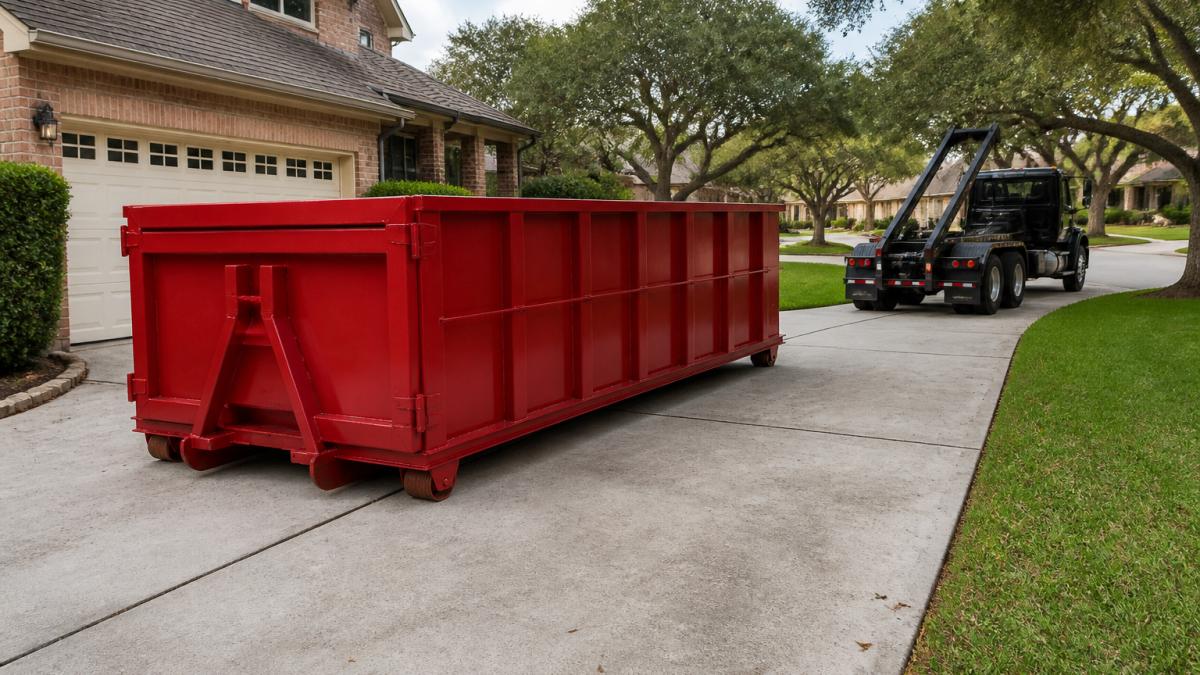
The delivery truck needs a clear path to your placement location. Measure these distances before delivery:
- Width: The truck needs at least 12 feet of clear width. Check gates, alleyways, and driveways.
- Height: Look for power lines, tree branches, or roof overhangs.
- Length: The truck is roughly 30-35 feet long. Ensure it can turn into your driveway without hitting obstacles.
- Turning radius: The truck needs space to position the dumpster. Avoid tight corners.
If your driveway is tight, consider placing the dumpster on the street (if permitted by local regulations) or in a side yard with better access.
Overhead power lines are serious hazards. If the placement area is within 15 feet of power lines, contact your utility company before scheduling delivery. A dumpster contacting power lines creates a safety emergency.
Driveway Protection for Dumpster Rental: Surface-Specific Tips
A dumpster sitting on your driveway for days or weeks can cause damage.
For asphalt driveways, protection is critical.
For concrete driveways, protection is recommended but less urgent than asphalt.
For gravel or unpaved surfaces, plywood is essential for stability.
For lawns or landscaped areas, avoid placing the dumpster directly on grass or soil.
Here’s how to set up surface protection:
- Clear the placement area of debris, branches, loose gravel, or vegetation
- Lay sheets of 3/4-inch plywood across the entire footprint where the dumpster will sit (measure the dumpster’s base dimensions if you have them)
- Overlap sheets slightly so the dumpster doesn’t rest between them or on a seam
- Make sure the plywood is level and stable before the dumpster arrives, use shims or gravel to level uneven spots
- Leave the plywood in place until after the dumpster is picked up
Plywood limitations: It protects against point loads and staining but not all damage.
Fill Out Form to Request Dumpster Rental →
Plywood protection takes 15 minutes to set up and prevents most cosmetic and minor structural damage. For asphalt and lawns, it’s nearly essential. For concrete, it’s recommended if the surface is newer or you want to preserve its appearance. For gravel, it’s required for stability.
What Can You Put in a Dumpster: Accepted and Prohibited Materials
Not everything can go in a roll-off dumpster. Some materials are dangerous, illegal, or cause landfill problems.
Accepted materials for most projects include:
- General household junk (furniture, appliances without refrigerant, boxes)
- Construction debris (wood, drywall, insulation, flooring)
- Roofing materials (shingles, underlayment, flashing)
- Yard waste (branches, leaves, grass clippings)
- Concrete, dirt, brick, and rock (best in a 15-yard dumpster; see note below)
- Metal scraps and aluminum
- Cardboard and paper
- Carpet and padding
- Plaster and plasterboard
Why heavy materials belong in a 15-yard dumpster: Concrete, dirt, brick, and rock are dense. A 15-yard dumpster is designed to handle these materials without exceeding weight limits.
Materials you cannot put in a dumpster:
- Hazardous waste (paint, solvents, chemicals, batteries, oil, refrigerants, pesticides), These are regulated by the EPA and state environmental agencies. Mixing them with regular trash contaminates the entire load and can make it unacceptable at the landfill.
- Electronics (TVs, computers, monitors, printers), These contain heavy metals and toxic materials. Many states have e-waste recycling laws that prohibit electronics in landfills.
- Tires (car, truck, or equipment tires), Most landfills charge separate fees for tires or refuse them entirely. Many tire shops will accept old tires for a small fee.
- Asbestos or materials containing asbestos (old insulation, floor tiles, roofing), Asbestos is a carcinogen and is heavily regulated (the EPA). Disturbing asbestos-containing materials requires professional abatement and specialized disposal.
- Propane tanks or compressed gas cylinders, These are explosion hazards and are strictly prohibited. They must be returned to the supplier or taken to a hazardous waste facility.
- Wet or contaminated soil, Soil contaminated with chemicals, oil, or other hazardous substances cannot go in a standard dumpster. It requires testing and may need specialized disposal.
- Radioactive materials, These are regulated by the Nuclear Regulatory Commission and have no place in a dumpster.
- Appliances with refrigerant (refrigerators, air conditioners, freezers), Refrigerant is an ozone-depleting substance and must be recovered by a certified technician before the appliance is scrapped.
How contamination affects your entire load: If a prohibited item is discovered during pickup or at the landfill, the entire load can be rejected.
If you’re unsure: Contact Austex Dumpsters before delivery to confirm materials. For hazardous items, dispose of them separately through proper channels:
- Paint and solvents: Take to a local hazardous waste collection event or facility (usually free or low-cost)
- Batteries: Many retailers (Best Buy, Home Depot) accept rechargeable batteries for free; car batteries can be returned to auto parts stores
- Motor oil and fluids: Auto parts stores and service stations accept used oil for free
- Electronics: Check your local e-waste recycling program or manufacturer take-back programs
- Appliances with refrigerant: Contact a local HVAC or appliance recycler
Mixing prohibited items with acceptable debris can get your entire load rejected. Keep hazardous materials separate and dispose of them through proper channels. A few minutes of planning prevents a costly rejection and project delay.
Create a Dumpster Delivery Preparation Checklist
A timeline keeps you organized and ensures nothing gets missed. Breaking preparation into phases makes the process manageable.
One Week Before Delivery
- Confirm your dumpster size and delivery date with Austex Dumpsters
- Walk your property and identify the placement location
- Measure access routes, width, height, and turning radius
- Check for overhead obstacles (power lines, branches, roof overhangs)
- Identify and move any vehicles, trash cans, or obstacles from the access route
- Lay down plywood or lumber if needed for surface protection
- Notify neighbors if the dumpster will be visible from their property
- Check local permit requirements and apply if necessary
24 Hours Before Delivery
- Clear the final placement area of any remaining obstacles
- Verify that the access route is completely clear
- Move vehicles from the driveway or street if the dumpster will be placed there
- Ensure the placement surface is level and stable
- Confirm the delivery time window with Austex Dumpsters
- Brief anyone who will be home during delivery on what to expect
- Gather any hazardous materials and plan separate disposal
Day of Delivery
- Be home or have someone present during the delivery window
- Clear the final 10 feet around the placement location
- Have the driver point out where the dumpster will sit
- Ask the driver if they see any issues with placement or access
- Confirm the pickup date and any special instructions
- Get contact information for questions during your rental period
| Preparation Phase | Key Tasks | Timeline |
|---|---|---|
| One week before | Confirm details, measure site, clear obstacles | 7 days out |
| 24 hours before | Final area clearing, surface check, confirm time | 1 day out |
| Day of delivery | Be present, communicate with driver, confirm pickup | Delivery day |
Clear Obstacles and Prepare the Delivery Area
The delivery truck needs a completely clear path. Walk the access route and remove parked cars, trash cans, hoses, branches, toys, and any obstacles. Clear a 10-foot radius around the placement location to give the driver room to position the container and ensure it’s level.
Walk the route at dawn or dusk when you can see shadows. This helps you spot overhead hazards you might miss in bright daylight.
Confirm Permits and Property Access
Some municipalities require permits for dumpsters on residential property. Call your local city or county office to ask about permit requirements, placement restrictions, time limits, and material regulations. Apply at least one week before delivery. If your property is in an HOA, check their rules too. Sorting this ahead prevents delivery day surprises.
How to Prepare for Dumpster Delivery: Final Steps Before Arrival
Preparing for dumpster delivery is straightforward when you break it into steps. Assess your project, choose your location, protect your property, and clear the way.
At Austex Dumpsters, we handle thousands of deliveries. Most go smoothly because customers prepare properly. A few minutes of planning prevents delays, damage, and frustration.
Ready to schedule your dumpster rental? Contact Austex Dumpsters for a delivery quote and same-day availability.
Frequently Asked Questions
What should I do before a dumpster is delivered?
Before dumpster delivery, measure your access route and clearance height, remove vehicles and obstructions from the placement area, check for overhead power lines and branches, and confirm the ground is flat and stable. Clear at least 2 feet on each side of where the dumpster will sit. If you have a driveway, lay down plywood or lumber to protect the surface. Notify neighbors if needed and verify any local permits are in place. A few days before delivery, contact your rental company to confirm the delivery window and ask if there’s anything specific you should do for your property type.
Where should I place a roll-off dumpster?
Place your roll-off dumpster on a flat, level, and stable surface, ideally a driveway or parking area. Avoid soft ground, gravel, or grass, which can shift under the weight. Ensure the delivery truck has a clear, straight access route with at least 12 feet of width and sufficient turning space. Check overhead clearance for power lines and tree branches, allowing at least 14 feet of height. Keep the placement area at least 2 feet away from vehicles, trash bins, and other obstructions. If placement is on a driveway, protect the surface with plywood first.
Can a dumpster be placed on a driveway?
Yes, a dumpster can be placed on a driveway, and it’s often the best location because driveways are flat, stable, and provide good truck access. However, protect your driveway surface with plywood or lumber before the dumpster arrives. Concrete driveways are more durable than asphalt, but both benefit from protection. Use ¾-inch plywood or 2×8 lumber boards to distribute the dumpster’s weight evenly and prevent cracking, staining, or indentation. This protection is especially important if the dumpster will sit for more than a few days.
How much space should I clear for dumpster delivery?
Clear at least a 12-foot-wide access route for the delivery truck and allow 2 feet of clearance on each side of the dumpster’s final position. Measure the height of overhead obstacles like power lines and tree branches, you need at least 14 feet of clearance. Remove any vehicles, trash bins, bikes, or other objects from the placement area and the path leading to it. If the area is tight, measure the exact dimensions and share them with your rental company before delivery so the driver can plan the best approach.
Preparing your property for dumpster delivery removes the biggest source of project delays. A clear access route, stable placement surface, and realistic material estimates mean your rental arrives on time and your project stays on track. Austex Dumpsters provides expert guidance on sizing and placement to keep your project moving. Fill out a form to request a dumpster rental quote and confirm same-day delivery availability for your project.