
Table of Contents
- 1. Choose the Right Dumpster Size for Your Roofing Project
- 2. Understand Dumpster Rental Weight Limits for Shingles
- 3. How to Calculate Roofing Waste Volume Before Ordering
- 4. Plan Strategic Dumpster Placement for Roof Replacement
- 5. Master Loading Techniques and Safety for Roofing Debris
- Prepare Your Site and Understand Regulations
- Frequently Asked Questions
Last Updated: September 30, 2026
Learning the top 5 dumpster rental tips for roofing projects means managing debris efficiently. The biggest mistake homeowners and contractors make isn’t choosing the wrong dumpster size, it’s not thinking through the logistics before materials start coming down. At Austex Dumpsters, we’ve helped hundreds of roofing projects stay on schedule by addressing the real pain points: weight limits, placement challenges, and loading techniques that most guides skip over entirely.
This guide covers the top 5 dumpster rental tips for roofing projects that actually matter. You’ll learn how to calculate waste volume, avoid overage fees, protect your property, and handle the specific challenges of shingle and debris removal. Below, we’ll show you exactly how to approach each decision so your project moves forward without delays or surprises.
1. Choose the Right Dumpster Size for Your Roofing Project
The most common mistake is underestimating volume, then scrambling for a second dumpster mid-project. The right size depends on your roof’s square footage and what materials you’re removing.
Understanding Cubic Yard Capacity
A roll-off dumpster’s capacity is measured in cubic yards. One cubic yard equals 27 cubic feet, roughly the size of a large refrigerator. Asphalt shingles are bulky but lightweight relative to their volume, which is why they take up space faster than you’d expect.
For residential roofing, shingles and felt underlayment compress somewhat during loading, but they still occupy significant space. A typical 1,000-square-foot roof removal generates 6-8 cubic yards of debris when you include old shingles, underlayment, and any decking material that needs replacement.
Sizing for Residential vs. Commercial Roofing
Residential roofing projects typically fit in a 20-yard or 25-yard dumpster. A 20-yard container holds 20 cubic yards and works well for roofs under 1,500 square feet. For larger residential projects or when you’re also removing decking material, a 25-yard dumpster provides breathing room.
Commercial roofing jobs often require a 25-yard or 30-yard dumpster depending on the building footprint and scope of work. If your project involves heavy materials like concrete pavers or slate tiles, you’ll need different sizing rules, those materials have weight restrictions that override volume calculations (more on that in Tip 2).
Austex Dumpsters offers 15-yard, 20-yard, 25-yard, and 30-yard roll-off dumpsters. The 15-yard size handles general debris, but there’s an important distinction for heavy materials covered in the next section.
2. Understand Dumpster Rental Weight Limits for Shingles
Weight limits are where most roofing projects run into trouble. You can’t see weight the way you see volume, which makes it easy to exceed limits without realizing it until the overage bill arrives.
Asphalt Shingle Weight Considerations
Asphalt shingles weigh roughly 2-3 pounds per square foot depending on the shingle grade. For a 1,000-square-foot roof, you’re looking at 2,000-3,000 pounds of shingles alone. Add underlayment, flashing, and any decking removal, and your total weight climbs quickly, often to 4,000-6,000 pounds for a standard residential removal.
Here’s what catches people off guard: a 20-yard dumpster filled with shingles might hit weight limits before it looks full. Shingles compress under their own weight, so a visually full dumpster can actually be heavier than you’d estimate.
Austex Dumpsters’ weight allowances depend on dumpster size and rental terms. Contact them for specific tonnage details on your project, but understand that overage fees apply when you exceed limits. For heavy material like concrete, dirt, brick, or rock, a 15-yard dumpster is required, these materials cannot go in 20-, 25-, or 30-yard dumpsters. The good news: if you fill a 15-yard dumpster with clean concrete, dirt, brick, or rock with no trash or other contamination, you may receive a break on tonnage charges.
Avoiding Overage Fees
The easiest way to avoid overage fees is to be conservative with your size estimate. If you’re on the fence between a 20-yard and a 25-yard dumpster, choose the 25-yard. The difference in rental cost is usually smaller than a single overage charge.
Track what’s going into the dumpster as the project progresses. If you’re halfway through and the container is already three-quarters full, you know you need to plan for a second delivery or adjust your scope. Don’t wait until the final day to realize you’ve miscalculated.
3. How to Calculate Roofing Waste Volume Before Ordering
Accurate volume estimates prevent the scramble for additional dumpsters and the stress of overage fees. This calculation method works for most residential roofing projects.
Square Footage to Debris Volume Formula
Start with your roof’s total square footage. For a single-story home with a simple roof pitch, measure the footprint length and width, then multiply by 1.2 to account for the slope. A 30-foot by 40-foot footprint on a standard-pitch roof is roughly 1,440 square feet.
Asphalt shingles and underlayment generate approximately 0.006 to 0.008 cubic yards per square foot of roof. Using the mid-range estimate of 0.007 cubic yards per square foot:
1,440 sq ft × 0.007 = 10 cubic yards
Fill Out Form to Request Dumpster Rental →
This calculation assumes you’re removing shingles and felt underlayment only. If you’re also removing decking or dealing with multiple roof layers, add 20-30% to your estimate.
Accounting for Underlayment and Decking Removal
Old roofs often have multiple layers of underlayment or even old shingles underneath new ones. If your project involves stripping down to the decking, your volume estimate should increase by 30-50% depending on what you find.
Decking removal (plywood or OSB) adds significant volume. A typical decking removal on a 1,000-square-foot roof adds 2-3 cubic yards to your total estimate.
4. Plan Strategic Dumpster Placement for Roof Replacement
Where you position the dumpster affects both safety and project efficiency. Poor placement costs time and creates liability issues.
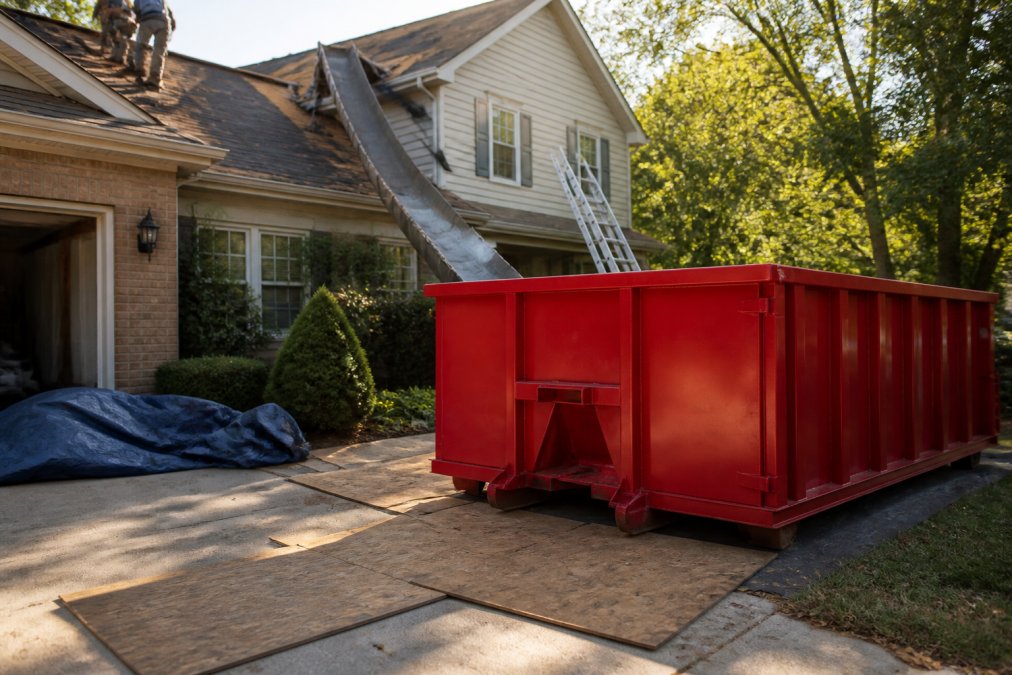
Protecting Your Driveway and Landscaping
Ensuring Work Area Accessibility
The dumpster needs to be close enough to the work area that roofing debris can be efficiently loaded, but not so close that it blocks worker movement or creates safety hazards. Ideally, position it 15-20 feet from the base of the roof where workers are removing materials.
5. Master Loading Techniques and Safety for Roofing Debris
How you load the dumpster directly impacts project timeline and safety. Poor loading wastes space and creates hazards.
Efficient Loading and Load Distribution
Break large pieces of decking or roofing material into smaller sections before throwing them in. Whole sheets of plywood or large pieces of metal flashing take up disproportionate space and are harder to arrange efficiently.
Safety Considerations for Roofing Debris
Asphalt shingles have sharp edges where they’ve been cut or nailed. Wear heavy work gloves and long sleeves when handling them. Metal flashing and roof penetration materials have sharp edges, handle carefully and consider wrapping sharp edges with tape before loading.
Prepare Your Site and Understand Regulations
Before your dumpster arrives, prepare the site and confirm local requirements.
Site Preparation for Dumpster Delivery
Clear the delivery area of obstacles, parked cars, landscaping debris, or other obstacles that block the truck’s path. The delivery truck needs a clear, level route to position the dumpster where you want it.
Permit Requirements and Local Disposal Regulations
Some municipalities require permits for dumpster placement on public property (like streets or sidewalks). If your dumpster will sit partially on the street, contact your local building department before scheduling delivery. Permits typically take a few days to obtain and can delay your project if you wait until the last minute.
Frequently Asked Questions
What size dumpster rental do I need for a roof replacement?
For most residential roofing projects, a 20-yard or 25-yard dumpster rental works well for tear-offs up to 1,500 square feet. Larger commercial roofing projects may require a 30-yard dumpster. The best way to determine your exact needs is to calculate your roof’s square footage and account for the weight of asphalt shingles, underlayment, and any decking removal. Austex Dumpsters provides expert guidance to help you select the right size so you don’t pay for extra capacity or run out of space mid-project.
Are there weight limits for roofing debris in dumpster rentals?
Yes, every dumpster rental has a tonnage allowance that varies by size and rental duration. Asphalt shingles are relatively lightweight compared to other roofing materials, but accumulated weight from shingles, underlayment, nails, and decking can add up quickly. Understanding your dumpster rental weight limits for shingles helps you avoid surprise overage fees. If your project involves heavy materials like concrete or brick, those must go in a 15-yard dumpster specifically designed for heavy loads, which may qualify for tonnage breaks when filled exclusively with clean heavy materials.
How do I calculate roofing waste volume before ordering a dumpster?
Start with your roof’s total square footage. A standard residential roof generates approximately one cubic yard of debris per 100 square feet of roofing material removed. Multiply your roof size by this ratio, then add 20-30% for underlayment, decking removal, and debris settling during transport. For example, a 1,200 square-foot roof typically generates 12-15 cubic yards of waste. Always round up to account for miscalculation. Austex Dumpsters can help you refine this estimate based on your specific project scope.
What should I do to prepare my driveway for dumpster delivery?
Clear the delivery area of vehicles, debris, and obstacles at least 24 hours before your dumpster rental arrives. Mark the exact placement location with cones or tape to help the driver position it correctly. For asphalt or concrete driveways, place plywood or protective boards under the dumpster feet to distribute weight evenly and prevent damage. Ensure the delivery area is level and has at least 12 feet of clearance on each side. Confirm that power lines and tree branches won’t interfere with the delivery truck’s approach.
Can I put asphalt shingles and other roofing materials in any dumpster rental size?
Asphalt shingles work in any dumpster size, but heavy materials like concrete, brick, dirt, or rock must go exclusively in a 15-yard dumpster. Do not mix heavy materials with shingles in larger containers. Asphalt shingles alone fit comfortably in 20-yard, 25-yard, or 30-yard dumpsters depending on your project volume. Austex Dumpsters can advise on the best container for your specific debris mix to ensure compliance and avoid fees.